Back in 1992, Gov. Robert P. Casey of Pennsylvania was a leading figure in the Democratic Party who had just come off a triumphant re-election in 1990 over his Republican opponent. As the 1992 Democratic National Convention approached, Gov. Casey appeared to be an obvious candidate to address the delegation at some point. In fact, Casey himself believed he could have been the keynote speaker.1 Political allegiances, however, prevented this from ever happening.
The reason that the Democratic National Committee did not invite Gov. Casey to speak to the convention is quite simple: Gov. Casey wished to deliver a fervent pro-life speech in which he would defend the dignity of the unborn and voice opposition to his party's stance on abortion. [Very important note: Casey was not shunned just for his "pro-life views" per se, but for his clear wish to deliver a pro-life speech. This is an important distinction.2]
A speech denouncing abortion would have been a disaster for the Democrats, and convention organizers knew this. Why? A pro-life speech would have turned the convention from an image of unity and strength into one of utter disarray. Imagine the ensuing media coverage: "A Party Divided!" "Casey Scolds Democrats!" "Casey Topples DNC Unity!" In the light of the full context of events, the decision by the DNC to forbid Casey from speaking is completely understandable.
Many Democrats angrily deny that Casey was improperly shunned. But after combing through contemporaneous media reports from 1992, even liberal journalist Kevin Drum (Washington Monthly) has concluded "that the real reason Casey was prevented from speaking was because he wanted to give a pro-life speech. Clinton was keeping a tight lid on the convention and wanted no dissent on an issue that he considered important." Drum also found that "virtually 100% of the news coverage … assumed that Casey's abortion stand was the reason he wasn't allowed to speak."3 Among the quotes he found:
July 15, 1992, CBS This Morning, Bob Beckel: "It's going to do a — take a lot to repair the damage there, I think. So they could have treated Casey better but don't underestimate — the Democrats are not going to try to fudge it on this issue. You've got to be choice on this issue."
July 15, 1992, Daily Oklahoman: Asked why Casey was not allowed to speak, [James] Carville said, "The convention schedule is set. The Democrats of the country have spoken as to the direction they want the country to go," he said in defending refusal to deviate from Clinton's agenda.4
+_+_+_+_+_+_+_+
There's more:
In his stirring autobiography called Fighting for Life (1996), Gov. Casey recounts his "banishment" from the 1992 convention, which was held at Madison Square Garden in New York City from July 13 to July 15. Eyewitness accounts also support Casey’s narrative.5
Historical context is very important in learning the truth about this story. Less than three weeks before the convention, Gov. Casey had been a defendant in the monumental Supreme Court case Planned Parenthood of Pennsylvania vs. Casey. Casey was sued by Planned Parenthood after signing a law which required a 24-hour waiting period and parental consent (for minors) for abortions. The law also banned abortions for the purpose of gender selection.6 Gov. Casey's lawsuit nearly brought Roe v. Wade to the point of being overturned.
Needless to say, Gov. Casey was not a popular figure among the NARAL / pro-choice crowd, who was especially vocal during the '92 campaign. The pro-choice movement pulled out all the stops. The Feminist Majority mobilized millions of voters with the immensely popular "Rock for Choice" crusade. Using well-known rock groups who had the ears of impressionable young voters, "Rock for Choice" blared all over the national media, and its mission was not the re-election of President George H.W. Bush. Its objective was political change.
By becoming such a powerful lobbying and political force, the pro-choice movement gained the whole-hearted support of Bill Clinton. Witness the following:
On the very day of the historic Pennsylvania vs. Casey Supreme Court ruling (June 29), candidate Bill Clinton spoke directly with NARAL Pro-Choice America president Kate Michelman. According to Michelman's 2005 chronicle With Liberty and Justice for All, Michelman personally advised Clinton upon the ruling. In turn, Clinton told Michelman (emphasis added), "It's awfully good news that Roe was upheld … I want you to know that you can count on me to continue to stand up for a woman's right to choose."7
Check out this photo and caption from Michelman's With Liberty and Justice for All
(red and yellow underline added)8:
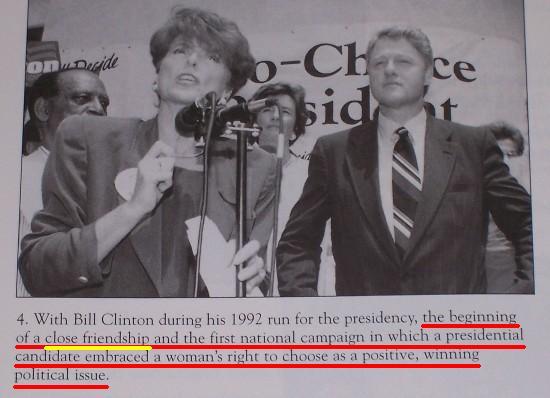
Notice the words "Pro-Choice President" behind Michelman and Clinton.
So here we have a confirmed alliance between candidate Clinton and the pro-choice movement. Is it any wonder why the DNC would not want Gov. Casey to stand in front of the nation and deliver a forceful pro-life address? Such a speech would have thrown the convention into bedlam!
What remains remarkable, however, is how events transpired before the July 13 start of the convention and the utter rudeness that ensued.
According to his autobiography, about a week and a half before the convention, Casey wrote a July 2 letter to Ron Brown, DNC chairman, requesting an opportunity to speak at Madison Square Garden. Casey's letter made it perfectly clear that he wished to address the convention about the Democratic Party's alliance with pro-choice factions. "The platform [committee] draft … has the effect of placing the national party even more squarely within the abortion-on-demand camp. I believe this is a serious mistake for the party and would like the opportunity to present this point of view." (emphasis mine)
Ron Brown never responded to Casey’s letter.9 Brown was later quoted as having told Casey, "Your views are out of line with those of most Americans."10
Gov. Casey tried another letter upon arriving at the convention on July 13. This one was addressed to Gov. Ann Richards of Texas, the chairperson of the convention. Richards did not respond either.11 Said one observer, "Eighty percent of the Pennsylvania delegation were wishing Governor Casey would get lost on the subway."12
Casey eventually received a carbon-copy of a letter – not even addressed to him – that denied his right to speak because "it was out of order" (Casey’s words).
On July 14, the second day of the convention, a full-page ad which Casey organized was published in the New York Times. Entitled "The New American Compact," it was signed by pro-lifers, both Democrats and Republicans, liberals and conservatives.13 It stated, in part, that,
"[I]n January 1973… [in Roe vs. Wade] seven unelected justices performed the most momentous act of exclusion in our history: they deprived every human being, for the first nine months of his or her life, of the most fundamental human right of all — the right to life."
Gov. Casey was determined to voice his "strong dissent based on the party’s historic commitment to protecting the powerless."14
What actually transpired at the convention itself, however, was simply a humiliation of Gov. Casey. "I would be publicly humiliated by my own party," wrote Casey.15
From his "nosebleed" seats far, far back in the arena, Gov. Casey watched as Kathy Taylor, a pro-choice activist from Pennsylvania, spoke to the convention. Less than two years earlier, the Republican Taylor had worked on behalf of Casey’s gubernatorial opponent, Barbara Hafer, whom Casey defeated to win reelection!16 Recalled Casey,
And so from my seat in the outer reaches of the Garden, I watched a pro-choice Republican supporter of my pro-choice Republican opponent, whom I had defeated by a million votes to be re-elected as Democratic governor, proudly proclaiming her allegiance to the pro-choice forces.17
The humiliation did not end there. After her address, in which she shared the podium with five other pro-choice women, DNC officials sent Taylor along with a camera crew to search for Casey and further humiliate him.18 Luckily, Casey was tipped off, and he avoided more national embarrassment.
The spectacle was so pathetic that the next day Al Gore called Gov. Casey to apologize.19
And there were even more insults. Karen Ritter, a Pennsylvania legislator, sold large buttons at the convention featuring a picture of Casey dressed as the Pope.20 Classy, eh?
"But, wait!" you cry. "Casey did not endorse Bill Clinton! That was the real reason Casey did not speak."
This fake "reason" was rebutted years ago, by Gov. Casey himself. Again, from his autobiography (emphasis mine):
The official line from the convention publicity machine was that I was not permitted to speak because I hadn’t endorsed Clinton. But if that’s the case, why had Kathleen Brown, state treasurer of California and sister of presidential hopeful Jerry Brown, been permitted to address the convention? She hadn’t endorsed the nominee, either.21
In addition, only three days after the convention ended, the New York Times quoted Gov. Casey, "I support the ticket, period, end of quote."22
So there you have it: The truth about Gov. Bob Casey and the 1992 Democratic National Convention.
____________________
Notes:
1 Nat Hentoff, “Life of the Party,” New Republic, June 19, 2000. Downloaded January 2006 from https://swiss.csail.mit.edu/~rauch/no-violence/civil/hentoff_casey.html.
2 In fact, a number of pro-life Democrats did address the DNC convention, but no one stirred the abortion issue .
3 Kevin Drum, "Political Animal: The Curious Incident of the Governor Who Didn't Speak at the Convention," Washington Monthly, March 6, 2005. https://www.washingtonmonthly.com/archives/individual/2005_03/005787.php. (Note: Hentoff and Drum are both avowed liberals. Hentoff is pro-life. Drum: "My conclusion: In fact, [Casey] was prevented from speaking because he wanted to give a pro-life speech.")
4 Ibid.
5 William McGurn, “Life of the Party,” National Review, October 28, 2004. https://www.nationalreview.com/comment/mcgurn200410281138.asp.
6 Gov. Robert P. Casey, Jr., Fighting for Life (Dallas: Word Publishing, 1996), pp. 149-150.
7 Kate Michelman, With Liberty and Justice For All (New York: Hudson Street Press, 2005), p. 112.
8 Ibid. The copyrighted NARAL/Pro-Choice America photo is shown here and with the intended application and accordance of the "fair use" doctrine.
9 Casey, Fighting for Life, p. 186.
10 Nat Hentoff, “Life of the Party,” New Republic, June 19, 2000. Downloaded January 2006 from https://swiss.csail.mit.edu/~rauch/no-violence/civil/hentoff_casey.html. See also Kevin Drum, "Political Animal: The Curious Incident of the Governor Who Didn't Speak at the Convention," Washington Monthly, March 6, 2005. https://www.washingtonmonthly.com/archives/individual/2005_03/005787.php. (Note: Hentoff and Drum are both avowed liberals. Hentoff is pro-life. Drum: "My conclusion: In fact, [Casey] was prevented from speaking because he wanted to give a pro-life speech.")
11 Casey, Fighting for Life, p. 186.
12 Michael Decourcy Hinds, "The 1992 Campaign: Pennsylvania; Democratic Ticket Heads Into Fertile Territory," New York Times, July 19, 1992, section 1, page 20.
13 The text of the actual New York Times ad can be viewed at https://prolife.liberals.com/articles/compact.html.
14 Casey, Fighting for Life, p. 186.
15 Ibid., p. 190.
16 Ibid., p. 190.
17 Ibid., p. 191.
18 Hentoff, “Life of the Party.”
19 Hentoff, “Life of the Party.” The phone call is also recounted in Casey, Fighting for Life, p. 191.
20 Casey, Fighting for Life, p. 190.
21 Ibid., p. 191.
22 Michael Decourcy Hinds, "The 1992 Campaign: Pennsylvania; Democratic Ticket Heads Into Fertile Territory," New York Times, July 19, 1992, section 1, page 20.